


Buy a plan
Pick a destination, data allowance and validity period.





There is no deadline for first use. You can buy now and keep your plan for a future trip.
Compare Israel eSIM plans for Jerusalem's Old City, the Tel Aviv beachfront, Haifa's terraced slopes and the Dead Sea below sea level. Set the allowance against a week that pauses from Friday afternoon to Saturday nightfall, and check the territory the offer itself names.
Israel is compact enough that Jerusalem, Tel Aviv and the Dead Sea all sit within a couple of hours of each other, and dense enough that the differences between them matter. Jerusalem's Old City is a grid of narrow stone-walled alleys with covered souk sections and thick masonry, so what reaches a handset changes from lane to lane. Tel Aviv is flat and continuous along the shore. The Dead Sea lies roughly 430 metres below sea level, with Route 90 running long empty desert stretches between the resort strips. One thing shapes every itinerary here: from Friday afternoon to Saturday nightfall most public transport stops, including the trains.
Refund policy
We always refund the full amount you paid when you request it, whether your eSIM is unused, partly used or fully used. There is no time limit for requesting a refund.
No first-use deadline
Validity does not start until your eSIM connects to a supported network at your destination. There is no deadline for first use. You can buy now and keep your plan for a future trip.
Secure checkout
Cards, Apple Pay & Google Pay — encrypted by Paysera.
24/7 support in all languages
Instant replies guaranteed.
Set up the Israel profile before flying, using a trusted connection, and keep the order details separately. Validity does not start until the eSIM first connects to a supported mobile network in Israel; follow the plan’s data-line instructions before entering the Old City’s covered markets. Ben Gurion makes the transfer easy: the railway station under the terminal reaches Tel Aviv's central stations in about fifteen to twenty minutes and Jerusalem–Yitzhak Navon in roughly twenty-five to thirty. Check the day of the week before relying on it, and leave the home contract's data off unless being billed is a decision you have made.
Pick a destination, data allowance and validity period.
Scan the QR or auto-install in the app — no physical SIM.
Data activates on first connection at your destination.
Pick the profile closest to your trip. The estimate assumes normal use — maps, messaging, photos, a short call home.
As a rule of thumb, a 3–4 day city break runs on about 1–3 GB, a one-week trip on 3–5 GB, a two-week multi-country tour on 8–12 GB, and working on the road takes about 1 GB a day, so 15 GB or more for two weeks.
In total, a 10 GB data allowance covers roughly 3,300 shared photos, 167 hours of social media and browsing, 29 hours of video calls, 125 hours of music streaming, or about 2000 hours of maps and navigation. Messaging apps barely use data.
Jerusalem · City guide
Jerusalem holds the Old City with its Jewish, Muslim, Christian and Armenian Quarters, the Israel Museum with the Shrine of the Book and the Second Temple model, and Yad Vashem. The Old City is a dense grid of narrow, stone-walled alleys, some of it covered souk, and the masonry is thick enough that what a handset can reach varies from lane to lane and drops indoors. Save the walking route and any timed entry before going in. The fast train from Tel Aviv takes about thirty-five minutes into Yitzhak Navon.
Jerusalem eSIM — set up before you flyTel Aviv–Yafo · City guide
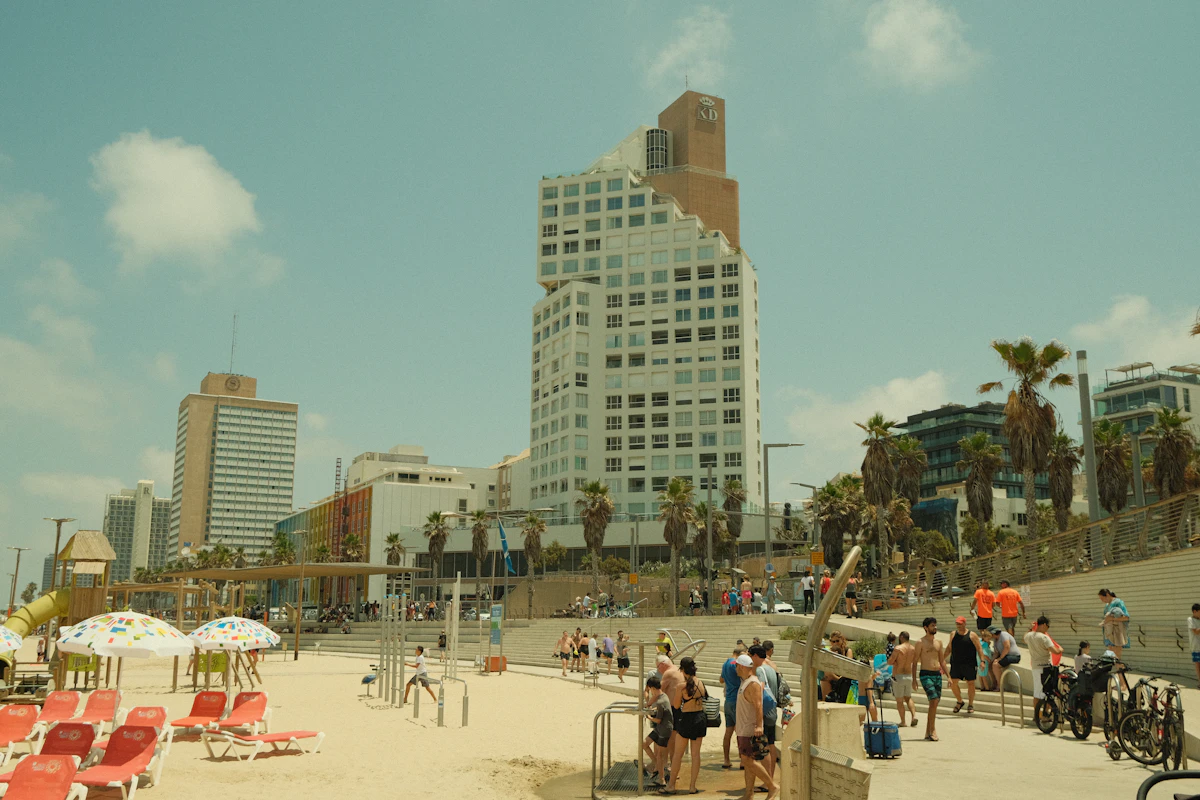
Tel Aviv runs its beachfront promenade, the Tayelet, all the way down to Old Jaffa, with the White City Bauhaus quarter around Rothschild Boulevard and Dizengoff, and Carmel Market inland. It is compact and flat, so most of a day here is walked rather than driven, and the shoreline is continuous built-up ground rather than the stone maze of Jerusalem. Gordon, Frishman, Hilton and Banana beaches sit along the same strip. Ben Gurion is about 20 kilometres out with a rail link into the central stations.
Tel Aviv–Yafo eSIM — set up before you flyHaifa · City guide
Haifa is built on steep terraces up the Carmel slope, so the city stacks vertically rather than spreading: the Bahai Gardens and the Shrine of the Bab descend the hillside in tiers, with Stella Maris above and the German Colony below. It sits on the coastal rail line, and trains run the shore route north from Tel Aviv in about an hour across roughly 90 kilometres. Between the terraces the ground itself blocks a good deal, so load the garden opening times and the return train before climbing.
Haifa eSIM — set up before you flyThe Dead Sea and Masada · City guide
The Dead Sea shore lies roughly 430 metres below sea level, the lowest land on earth, and visitors float rather than swim in the hypersaline water at Ein Bokek and Kalia. Masada National Park sits above it, reached by cable car or on foot up the Snake Path, which opens before dawn because the summer heat here is extreme. Ein Gedi Nature Reserve is close by. Route 90 links them through long empty desert stretches between resorts, so carry the route and the return offline before setting out from Jerusalem, about 100 kilometres and an hour and a half away.
The Dead Sea and Masada eSIM — set up before you flyWhy Horizon
Seven to ten days covers Jerusalem, Tel Aviv, the Dead Sea and one northern day, and the distances are short: Tel Aviv to Jerusalem is about 66 kilometres, Tel Aviv to Haifa about 90, Jerusalem to Masada about 100. The constraint is not distance but the week. From Friday afternoon to Saturday nightfall most public transport stops, including the trains, along with many shops and restaurants, so that stretch is planned around walking, taxis or a rental car. If the trip continues to Jordan for Petra and Wadi Rum, or to Sinai, treat each as a separate destination on the offer's own list, and check current crossing conditions from official sources before relying on any route.
Plan for
Israel
Compare the listed data allowances and validity periods for your destination.
Install over reliable Wi-Fi before departure and follow the plan's activation instructions.
Review the current price, data, validity and coverage before checkout. Horizon plans have no throttling.
When the selected plan supports reuse or top-ups, My eSIMs shows the eligible options for the installed profile.
We'll alert you as you approach your limit. If the plan supports a top-up, My eSIMs shows the eligible options.
Choose country, regional or global coverage and check every destination in the plan details.
Treat Friday afternoon to Saturday nightfall as a fixed constraint rather than a detail. Most public transport stops in that window, including the trains and most intercity buses, and many shops and restaurants close with it. The practical options are to stay put in one city and walk, to use taxis, or to have a rental car arranged before Friday. Plan the long transfers for other days, and download anything you will need, since live timetables are of little use when the service is not running.
Seven to ten covers Jerusalem, Tel Aviv, the Dead Sea and one day in the north. The distances are genuinely short — Tel Aviv to Jerusalem is about 66 kilometres and roughly an hour by road or thirty-five minutes on the fast train, and Tel Aviv to Haifa about 90 kilometres and an hour. What eats time is the density of Jerusalem, where the Old City alone can absorb two days, and the Shabbat window, which removes most of a day and a half from any moving itinerary.
It is the standard way to do it, and the reason is heat rather than romance. The Snake Path opens before dawn so the climb happens in the cool, and the cable car starts later in the morning for anyone who would rather ride. Masada sits about 100 kilometres from Jerusalem, roughly an hour and a half, so this is an early start whichever way you go up. Have the park times, the route and the return leg saved offline, because Route 90 runs long empty stretches on the way. Confirm current park access and heat-related trail restrictions before departure; opening before dawn does not guarantee the route will be open on your date.
You float rather than swim, because the water is hypersaline and the shore sits roughly 430 metres below sea level, the lowest land on earth. Two practical points come up constantly: do not shave beforehand, and keep the water out of your eyes, since it stings sharply. Ein Bokek and Kalia are the usual access points, with the Ein Gedi Nature Reserve nearby for a walk. Sessions are short by nature, so most people pair it with Masada in the same day.
For the coast and Jerusalem, public transport is enough. The rail line links Ben Gurion, Tel Aviv, Haifa and Jerusalem, with the fast train covering Tel Aviv to Jerusalem in about thirty-five minutes. A car earns its place for the Dead Sea, the Negev and the Galilee, where the routes run between resorts and villages rather than between stations. It also solves the Shabbat window, when most services stop from Friday afternoon until Saturday nightfall.
Only when that country is named on the plan's own destination list. Jordan is the common pairing for Petra, Wadi Rum and Amman, reached at the Yitzhak Rabin crossing near Eilat and Aqaba, the Allenby or King Hussein Bridge near Jericho, and the Jordan River crossing near Beit She'an; Sinai is reached at Taba beside Eilat. Crossing status, opening hours and entry rules change, so confirm them from official sources close to the date rather than relying on an older account, and check the coverage list separately.
Location alone cannot establish the cause. Reception may vary between stone alleys, covered markets and indoor spaces in the Old City, and along desert sections of Route 90; it also depends on the plan, device, partner network and settings. Try from a safe open location and leave the profile installed. If the problem continues, reopen the plan guide on Wi-Fi, confirm the Israel profile is enabled and selected for mobile data, follow its roaming and APN steps in order, and send support the order reference, handset model and problem location.
No. Horizon plans have no throttling. There is no daily limit that slows you down, so you can use your whole plan in one day if you need to. Your speed depends on the local network, your signal and how busy the network is. When your data allowance is used up, the plan stops rather than slowing down.
Yes. We always refund the full amount you paid when you request it, whether your eSIM is unused, partly used or fully used. There is no time limit for requesting a refund.