Validity follows the selected plan terms. 100% refund within 7 days if no data is used. If your eSIM doesn't work and we can't fix it, you get your money back.
Need broader coverage?
Explore our regional and global eSIMs — packages start from the shown price and include coverage for Bosnia and Herzegovina.
Add another country — each one is its own eSIM, all managed in one app.
Bosnia and Herzegovina
5 GB · 30 days
Total
€6.99
From the road
What travelers say about Bosnia and Herzegovina
51 customer reviews
EN
“I used the Horizon Balkans eSIM on a recent trip. The best part was not having to think about buying a new SIM every time I crossed a border. I used it for maps, WhatsApp, checking hotels, finding restaurants, and looking up beaches and places to visit.
The package covers Albania, Bosnia and Herzegovina, Bulgaria, Croatia, Greece, Montenegro, North Macedonia, and Serbia and I added Kosovo eSIM to the same order. I would use it again for another trip through the Balkans”
Bosnia eSIM for Sarajevo, Mostar and the Neretva valley
Compare Bosnia eSIM plans for Sarajevo and its bazaar, the Old Bridge at Mostar, the fortress at Banja Luka and the walled town of Trebinje. Size the data to a country crossed through tunnels, and check the territory list before any border day.
One fact here catches out drivers who never intended to visit at all. The country has just twenty kilometres of Adriatic coastline and a single coastal town, Neum, and that Neum corridor historically interrupted Croatia's coastal road — so a Dubrovnik to Split drive used to cross Bosnian territory whether or not that was the plan. The Pelješac Bridge now bypasses it, which means the same journey may or may not enter the country depending on the route taken. If your itinerary touches that coast, know which road you are on before you assume which plan applies.
Install the profile before you reach the region, on a connection you already trust, and keep the order details off the handset. Sarajevo International sits about twelve kilometres from the historic centre and much closer to the Ilidža suburb, with a shuttle to Baščaršija in roughly thirty minutes, trolleybus 103 or 107 to Dobrinja plus a ten to fifteen minute walk, or a taxi in twenty to twenty-five. Many visitors to Herzegovina instead fly into Dubrovnik or Split and cross by road, which makes the arrival a border question rather than an airport one — worth settling before you set off.
1
Buy a plan
Pick a destination, data allowance and validity period.
2
Install your eSIM
Scan the QR or auto-install in the app — no physical SIM.
3
Land & connect
Data activates on first connection at your destination.
Size it to your trip
Pick the profile closest to your trip. The estimate assumes normal use — maps, messaging, photos, a short call home.
As a rule of thumb, a 3–4 day city break runs on about 1–3 GB, a one-week trip on 3–5 GB, a two-week multi-country tour on 8–12 GB, and working on the road takes about 1 GB a day, so 15 GB or more for two weeks.
In total, a 5 GB data allowance covers roughly 1,700 shared photos, 83 hours of social media and browsing, 15 hours of video calls, 63 hours of music streaming, or about 1000 hours of maps and navigation. Messaging apps barely use data.
Important cities in Bosnia and Herzegovina
Sarajevo · City guide
Sarajevo
Sarajevo holds Baščaršija, the fifteenth-century Ottoman bazaar quarter with the Sebilj fountain, the Gazi Husrev-beg Mosque of 1531, the Latin Bridge, the Vijećnica, and the Tunnel of Hope museum near the airport. The Trebević cable car climbs to roughly 1,160 metres and the 1984 bobsleigh track, with the Yellow and White Fortress viewpoints below. The city sits in a steep-sided valley served by trams and trolleybuses and has no metro, so what thins reception here is the valley wall rather than anything underground.
Sarajevo eSIM — set up before you fly →
Mostar · City guide
Mostar
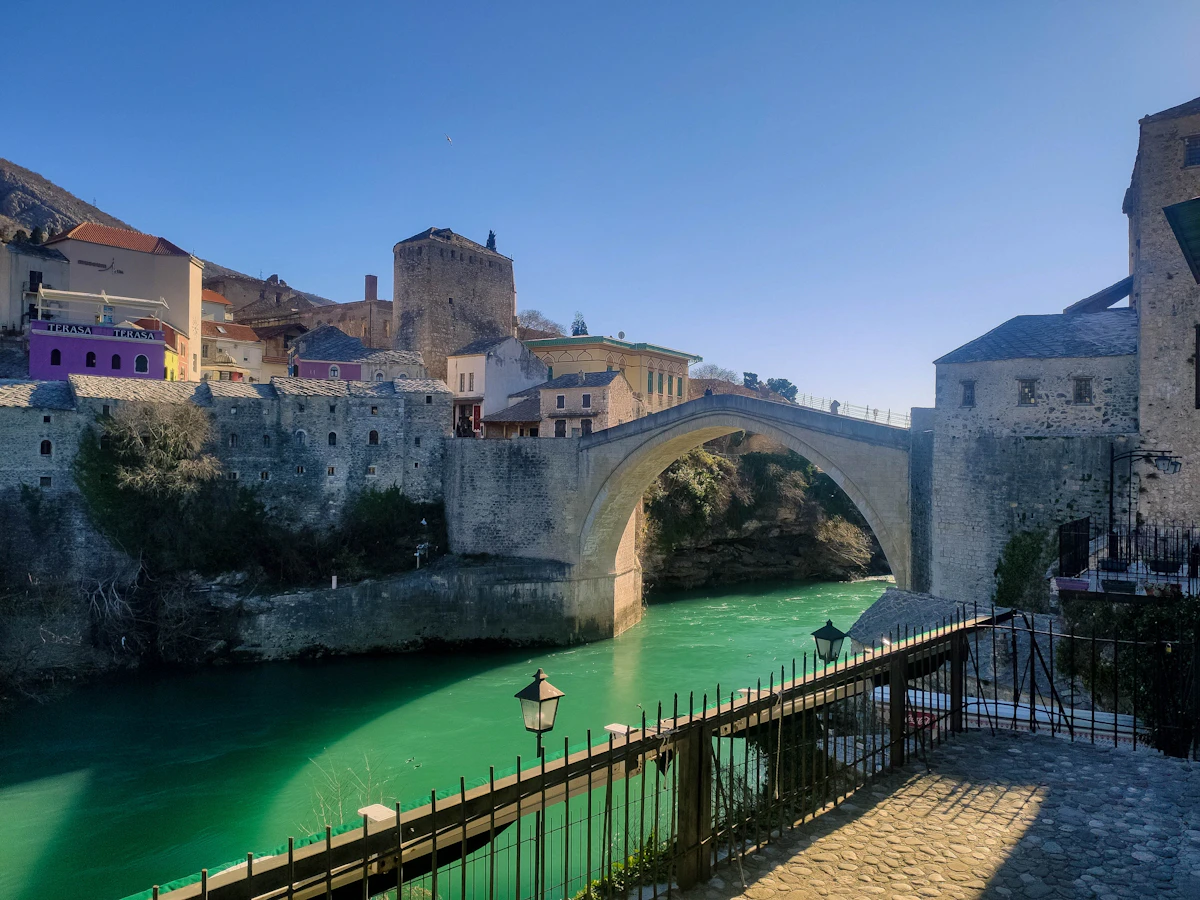
Mostar is built around Stari Most, the UNESCO-listed Old Bridge rebuilt in 2004, with the Kujundžiluk bazaar beside it and the Koski Mehmed-Pasha Mosque minaret as the viewpoint. Within easy reach are the Blagaj Tekke at the Buna river spring, the fortified village of Počitelj and the Kravice waterfalls, a twenty-six metre drop on the Trebižat. This is the hottest place in the country: July highs run 32 to 35 degrees and occasionally touch 40, while January highs still sit around 9 or 10.
Mostar eSIM — set up before you fly →
Banja Luka · City guide
Banja Luka
Banja Luka sits on the Vrbas with the Kastel Fortress on its bank, the Cathedral of Christ the Saviour on Trg srpskih vladara, and the Ferhadija Mosque of 1579, reconstructed and reopened in 2016. Upstream the Vrbas canyon is the rafting stretch. From Sarajevo it is roughly 193 kilometres and about three hours, and the road crosses mountain sections rather than running flat — which is the part of the drive where a live map is least useful and a saved route earns its keep.
Banja Luka eSIM — set up before you fly →
Trebinje and Neum · City guide
Trebinje and Neum
Trebinje keeps an eighteenth-century walled Old Town with a clock tower, the sixteenth-century Arslanagić Bridge, the Hercegovačka Gračanica monastery complex on Crkvina hill, and a plane-tree-shaded main square. It sits close to the Croatian border and Dubrovnik, roughly thirty kilometres and under an hour including the crossing, though queues vary. Neum, seventy-seven kilometres from Mostar, is the country's only coastal town along its twenty kilometres of Adriatic, with pebble and concrete-platform bays rather than long sand.
Trebinje and Neum eSIM — set up before you fly →
Why Horizon
Choose for the corridor, and count the borders
Five days covers Sarajevo, Mostar and a waterfall day comfortably, and the Sarajevo to Mostar corridor is the one leg that works well without a car — 126 to 129 kilometres, about two hours by road on the M-17 through the Neretva valley, or roughly two hours by train. Beyond that corridor a car is effectively required: bus coverage between cities is decent but thin to the parks and waterfalls. May to June and September to early October are the best months, because July and August are genuinely uncomfortable in Herzegovina while Sarajevo at around 550 metres stays near 20 degrees in July. If the trip continues into Croatia or Montenegro, count the crossings before you buy — each is a separate territory decision.
Horizon eSIM Before you travel
Plan for
Bosnia and Herzegovina
Compare plan details
Check device compatibility
Install over Wi-Fi before departure
Flexible choice
Better plans, built for real trips
Compare the listed data allowances and validity periods for your destination.
Before departure
Easy to use
Install over reliable Wi-Fi before departure and follow the plan's activation instructions.
Clear comparison
Compare the full plan
Review the current price, data, validity, coverage and fair-use terms before checkout.
Reuse when eligible
Reuse an eligible eSIM
When the selected plan supports reuse or top-ups, My eSIMs shows the eligible options for the installed profile.
Usage control
Stay connected
We'll alert you as you approach your limit. If the plan supports a top-up, My eSIMs shows the eligible options.
Multi-country
Global & regional plans
Choose country, regional or global coverage and check every destination in the plan details.
Frequently asked questions
Will I cross into Bosnia driving the Croatian coast?
It depends on the route, and the answer changed. The country has twenty kilometres of Adriatic coast and one coastal town, Neum, and that corridor historically interrupted Croatia's coastal road, so a Dubrovnik to Split drive crossed Bosnian territory whether or not anyone planned it. The Pelješac Bridge now bypasses the corridor, so the same journey may or may not enter the country. Check which road your navigation is actually giving you, and confirm the offer's territory list covers both sides before you assume one plan carries you through.
Is five days enough for Sarajevo, Mostar and the waterfalls?
Comfortably. Sarajevo takes two days between Baščaršija, the Gazi Husrev-beg Mosque, the Latin Bridge, the Tunnel of Hope museum and the Trebević cable car. Mostar takes one for the Old Bridge and the Kujundžiluk bazaar, and one more covers Blagaj Tekke at the Buna spring, Počitelj and the Kravice waterfalls together as a single loop. That leaves a spare day. The Sarajevo to Mostar leg is 126 to 129 kilometres, about two hours by road or roughly two by train.
Sarajevo to Mostar: train, bus or car?
The train is the scenic choice and takes about two hours, running twice daily along the Neretva through a long series of tunnels. The road is the M-17 through the Neretva canyon, 126 to 129 kilometres and roughly two hours and five to ten minutes, a winding valley route that includes the Ivan tunnel at the Ivan Sedlo pass around 967 metres. A car only becomes necessary beyond this corridor, where bus coverage thins out toward the parks and waterfalls.
How hot does Mostar actually get in summer?
Hot enough to reshape the itinerary. Mostar is the hottest place in the country, with July highs routinely between 32 and 35 degrees and occasional days touching 40, which makes midday sightseeing on an exposed stone bridge and bazaar genuinely hard. Sarajevo is a different climate at around 550 metres, averaging about 20 degrees in July with highs of 27 to 30. May to June and September to early October avoid the worst of it, and January highs in Mostar still sit around 9 or 10 if you would rather travel cool.
Can Blagaj, Počitelj and Kravice be done in one day?
Yes, and it is the standard loop out of Mostar. Blagaj Tekke stands at the Buna river spring, Počitelj is a fortified village on the way south, and the Kravice waterfalls drop twenty-six metres on the Trebižat. The three sit close enough together to make one unhurried day rather than three separate outings. A car or a driver makes it straightforward — this is exactly the kind of route where bus coverage thins out, since services between cities are decent but sparse toward the parks and waterfalls.
Is the country worth visiting in winter?
For the mountains, yes. Sarajevo holds snow roughly December to March, and Bjelašnica and Jahorina keep it into April, which gives a long season on the slopes that hosted the 1984 Games — the bobsleigh track above the city is reached by the Trebević cable car. Sarajevo itself averages around zero in January with lows of minus five to minus seven. Herzegovina is a different proposition: Mostar's January highs still sit around 9 or 10, so a winter trip can pair snow above with mild stone streets below.
The phone lost service in the Neretva valley — is that expected?
Very much so. The M-17 winds through the Neretva canyon with tunnels along the way, including the Ivan tunnel at the Ivan Sedlo pass around 967 metres, and the parallel railway runs through a long series of tunnels for much of the same stretch. Sarajevo itself sits in a steep-sided valley. Judge the plan on open ground rather than mid-canyon. If it genuinely fails there, use Wi-Fi to reopen the plan's own setup guide, confirm the profile is enabled and assigned to mobile data, work through its roaming and APN steps in order, and give support the order reference and handset model.
Can I share the connection with family in Sarajevo?
Where the selected plan and the device allow it, the connection can be shared as a hotspot — check the plan details and the phone's own settings before a visit depends on it. The habit that matters more here is the one the ground imposes anyway: addresses climb away from the tram line up lanes that a live map resolves poorly, so agree the meeting point and save it offline before setting out. Once you are indoors, household Wi-Fi carries the evening at no cost to the allowance.
What happens when a Bosnia plan runs out of data?
The profile stays installed and simply stops carrying data, which on a mountain road looks exactly like the tunnels doing it — so work out which of the two you have before repairing anything. Whether more data can be added to the same profile depends on the offer, as does the point at which its validity period begins, so read both in the plan's own terms rather than assuming. The practical defence is the one the terrain already asks for: pull down the next leg, the return timetable and the lodging address while there is still Wi-Fi.
Where next
Other destinations travellers pair with Bosnia and Herzegovina