Validity follows the selected plan terms. 100% refund within 7 days if no data is used. If your eSIM doesn't work and we can't fix it, you get your money back.
Need broader coverage?
Explore our regional and global eSIMs — packages start from the shown price and include coverage for Bulgaria.
Add another country — each one is its own eSIM, all managed in one app.
Bulgaria
5 GB · 30 days
Total
€2.99
From the road
What travelers say about Bulgaria
53 customer reviews
EN
“I used the Horizon Balkans eSIM on a recent trip. The best part was not having to think about buying a new SIM every time I crossed a border. I used it for maps, WhatsApp, checking hotels, finding restaurants, and looking up beaches and places to visit.
The package covers Albania, Bosnia and Herzegovina, Bulgaria, Croatia, Greece, Montenegro, North Macedonia, and Serbia and I added Kosovo eSIM to the same order. I would use it again for another trip through the Balkans”
EN
“I used the Europe Esim, went through different countries with it and it was working super fast 5G everywhere. Suprised for good!”
EN
“The eSIM worked perfectly during my trip around Europe. It was very easy to install, connected as soon as I arrived, and the internet was fast and reliable everywhere I went. It made travelling much easier because I did not need to buy local SIM cards. Very convenient and worth the price. I would definitely use it again.”
Bulgaria eSIM for Sofia, the old towns and the Black Sea
Compare Bulgaria eSIM plans for Sofia and Vitosha, the Plovdiv old town, Veliko Tarnovo above the Yantra gorge and the Black Sea resorts. Weigh the allowance against the travel days, then read the territory and hotspot rules named on the offer.
Sofia is unusual among capitals in having a mountain within its municipality: Vitosha rises directly above the city, so a capital-city day can end on a forested ridge. Check the mountain access services currently operating rather than assuming lifts or cable cars are running. The rest of Bulgaria varies just as much. Plovdiv's old town climbs cobbled slopes over three syenite mounds around a Roman theatre still used for performances. Veliko Tarnovo stacks in tiers around the Yantra river gorge on near-vertical ground. Then the coast runs long past capes and resort strips. Ridges, gorges and coastal stretches may affect reception depending on the network and device, so save the route and monastery timings before leaving the last town.
Add the Bulgaria profile before you travel, over a connection you already trust, and keep the order details off the handset. The plan you buy names the step at which it becomes the data line; follow that rather than a general guide. Sofia is easy here — Terminal 2 has its own metro station on line M4, reaching Serdika in the centre in about thirty minutes with trains every six to twelve. The coastal airports are shorter still: Varna about 7.5 kilometres out, Burgas about ten. Leave the home contract's data off unless being billed for it is a decision you have made.
1
Buy a plan
Pick a destination, data allowance and validity period.
2
Install your eSIM
Scan the QR or auto-install in the app — no physical SIM.
3
Land & connect
Data activates on first connection at your destination.
Size it to your trip
Pick the profile closest to your trip. The estimate assumes normal use — maps, messaging, photos, a short call home.
As a rule of thumb, a 3–4 day city break runs on about 1–3 GB, a one-week trip on 3–5 GB, a two-week multi-country tour on 8–12 GB, and working on the road takes about 1 GB a day, so 15 GB or more for two weeks.
In total, a 5 GB data allowance covers roughly 1,700 shared photos, 83 hours of social media and browsing, 15 hours of video calls, 63 hours of music streaming, or about 1000 hours of maps and navigation. Messaging apps barely use data.
Important cities in Bulgaria
Sofia · City guide
Sofia
Sofia holds the Alexander Nevsky Cathedral, the National History Museum and the tenth-century Boyana Church on the city's southern edge. Vitosha rises directly above within the municipality, so a city day can finish on a forested ridge. Check the mountain access services currently operating and do not assume lifts are running; reception may vary by location and network. The airport is well connected: Terminal 2 has its own station on metro line M4, about thirty minutes to Serdika. Rila Monastery is roughly 120 kilometres away, about two hours each way, and is a common day trip.
Sofia eSIM — set up before you fly →
Plovdiv · City guide
Plovdiv
Plovdiv's old town climbs steep cobbled hills built over three syenite mounds, with the Roman Theatre of Philippopolis still in use for performances and the restored National Revival houses lining the lanes above. The Kapana quarter sits below in the flat. South of the city the Rhodope foothills lead to Bachkovo Monastery, a common half-day. From Sofia it is about 145 kilometres, roughly an hour and a half by car and two to two and a half by bus or train. Save the theatre timings before the climb, since the lanes are narrow and steep.
Plovdiv eSIM — set up before you fly →
Veliko Tarnovo · City guide
Veliko Tarnovo
Veliko Tarnovo stacks in tiers around the Yantra river gorge, with houses on near-vertical slopes and Tsarevets Fortress on its own hill across the water. The Samovodska Charshia craft street runs through the old quarter, and the village of Arbanasi sits on the plateau above. Journeys across the Balkan Mountains may involve winding roads and mountain passes; check the actual route and conditions before continuing. From Plovdiv it is about 180 kilometres, roughly two and three-quarter hours by car. Load the fortress hours and onward bus before descending into the gorge.
Veliko Tarnovo eSIM — set up before you fly →
Varna and the coast · City guide
Varna and the coast
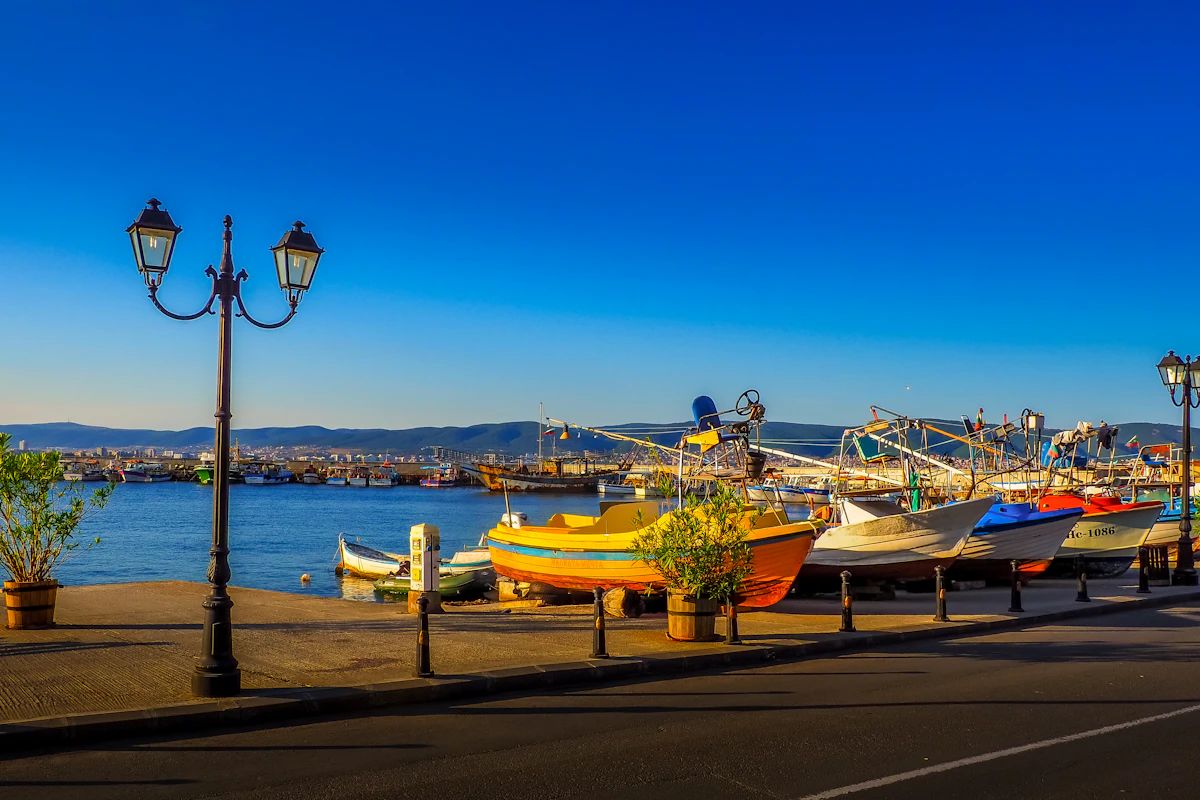
Varna holds the Archaeological Museum with the Varna Chalcolithic gold finds, the Roman Thermae and the Sea Garden park, and it is the northern gateway to a long coast road running past capes and resort strips. Golden Sands and Albena lie north, with quieter Kavarna and Kaliakra beyond; south around Burgas are the eight-kilometre sand strip at Sunny Beach, the walled peninsula town of Nessebar and the old wooden houses of Sozopol. The season runs roughly May to early October, and much of the strip is shuttered outside it. The airport is about 7.5 kilometres from the centre.
Varna and the coast eSIM — set up before you fly →
Why Horizon
Choose for the coast season or the mountain one
A stay of three or four days covers Sofia plus a Rila day trip; seven to ten adds Plovdiv, Veliko Tarnovo and the coast. Which season you pick changes the shape entirely. July and August fill the Black Sea strip; May to June and September to early October suit the old towns and monasteries better; and roughly mid-December to mid-April is the ski window at Bansko, Borovets and Pamporovo, when mountain roads toward Rila and the Rhodopes can be snow-slowed. Bulgaria is an EU member, but several of its neighbours are not — Türkiye, Serbia and North Macedonia among them — so check each by name on the offer rather than assuming a regional label covers the whole route.
Horizon eSIM Before you travel
Plan for
Bulgaria
Compare plan details
Check device compatibility
Install over Wi-Fi before departure
Flexible choice
Better plans, built for real trips
Compare the listed data allowances and validity periods for your destination.
Before departure
Easy to use
Install over reliable Wi-Fi before departure and follow the plan's activation instructions.
Clear comparison
Compare the full plan
Review the current price, data, validity, coverage and fair-use terms before checkout.
Reuse when eligible
Reuse an eligible eSIM
When the selected plan supports reuse or top-ups, My eSIMs shows the eligible options for the installed profile.
Usage control
Stay connected
We'll alert you as you approach your limit. If the plan supports a top-up, My eSIMs shows the eligible options.
Multi-country
Global & regional plans
Choose country, regional or global coverage and check every destination in the plan details.
Frequently asked questions
Is Rila Monastery doable as a day trip from Sofia?
Yes, and it is the standard one. Rila sits roughly 120 kilometres from Sofia, about two hours each way, so an early start leaves four or five hours on site and gets you back by evening. The road climbs into the Rila range, where reception thins between villages, and in winter snow can slow the approach considerably. Download the route, the return departure and any booking before leaving the city rather than relying on checking them at the monastery.
Coast or interior — which should I pick?
The month has a large influence on the choice. July and August are peak season on the Black Sea, when Golden Sands, Sunny Beach and the smaller southern villages are usually at full activity. Outside roughly May to early October many seasonal businesses close, transport thins and the coast road becomes quieter. The interior suits the shoulder months: Plovdiv, Veliko Tarnovo and the monasteries are easier to explore without peak heat or crowds. Check the actual services for your travel dates.
How many days does Bulgaria need?
A stay of three or four days is enough for Sofia with a Rila day trip and an evening on Vitosha. Seven to ten opens the classic loop: Sofia, then Plovdiv about 145 kilometres away, then Veliko Tarnovo another 180, then Varna and the coast a further 220. Those legs are two to three hours each by road and rather longer by bus, so a week is comfortable rather than rushed. Adding both the coast and a ski week means two separate trips in different seasons.
Is skiing in Bulgaria worth planning around?
It has a real season, roughly mid-December to mid-April, centred on Bansko, Borovets and Pamporovo, with January to early March the most dependable stretch. That window is the opposite of the coast's, so a ski trip and a beach trip are two different holidays rather than one itinerary. Mountain roads toward Rila and the Rhodopes can be snow-slowed in those months, so keep the route and the accommodation details saved offline before the last town.
Do I need a car, or do the buses work?
Buses link the four main stops reliably, so a first trip does not need a car. Sofia to Plovdiv runs two to two and a half hours by bus or train against about an hour and a half driving, and the other legs follow the same pattern. A car earns its place for the monasteries, the Rhodope villages and the smaller southern beaches, which sit away from the main routes. Decide by what is on the list rather than for the whole trip, and remember the coast road is long even where it is flat.
Does a Bulgaria plan work across the border into Türkiye or Greece?
Only when that country is named on the plan's own destination list, and here the distinction matters more than usual. Bulgaria and its neighbours Romania and Greece are EU members, reached at the Ruse–Giurgiu Danube bridge and at Kulata–Promachonas respectively; Türkiye, Serbia and North Macedonia are not, and are reached at Kapitan Andreevo, Kalotina and Gyueshevo. A single European heading therefore covers this region unevenly. Read the printed list and compare a regional package before setting off toward Edirne, Skopje or Niš.
No data after landing in Sofia — what should I check?
Terminal 2 is a good place to sort it out, since the metro station is right there and you can stay on airport Wi-Fi. Open the setup guide supplied with the plan rather than a generic one, confirm in order that the Bulgaria profile is enabled and that it is the line assigned to mobile data, then follow that plan's own roaming, network-selection and APN steps as written. Restart only where the guide says so. If it still will not connect, leave the profile installed and send support the order reference, the handset model and a screenshot.