


EN
“I used the Europe Esim, went through different countries with it and it was working super fast 5G everywhere. Suprised for good!” 




“I used the Europe Esim, went through different countries with it and it was working super fast 5G everywhere. Suprised for good!” “The eSIM worked perfectly during my trip around Europe. It was very easy to install, connected as soon as I arrived, and the internet was fast and reliable everywhere I went. It made travelling much easier because I did not need to buy local SIM cards. Very convenient and worth the price. I would definitely use it again.” Compare Portugal eSIM plans for Lisbon and Sintra, Porto and the Douro, and the Algarve cliff coast. Set the allowance against the days actually spent on the mainland, and read the territory and hotspot rules on the offer — Madeira and the Azores are listed as their own destinations.
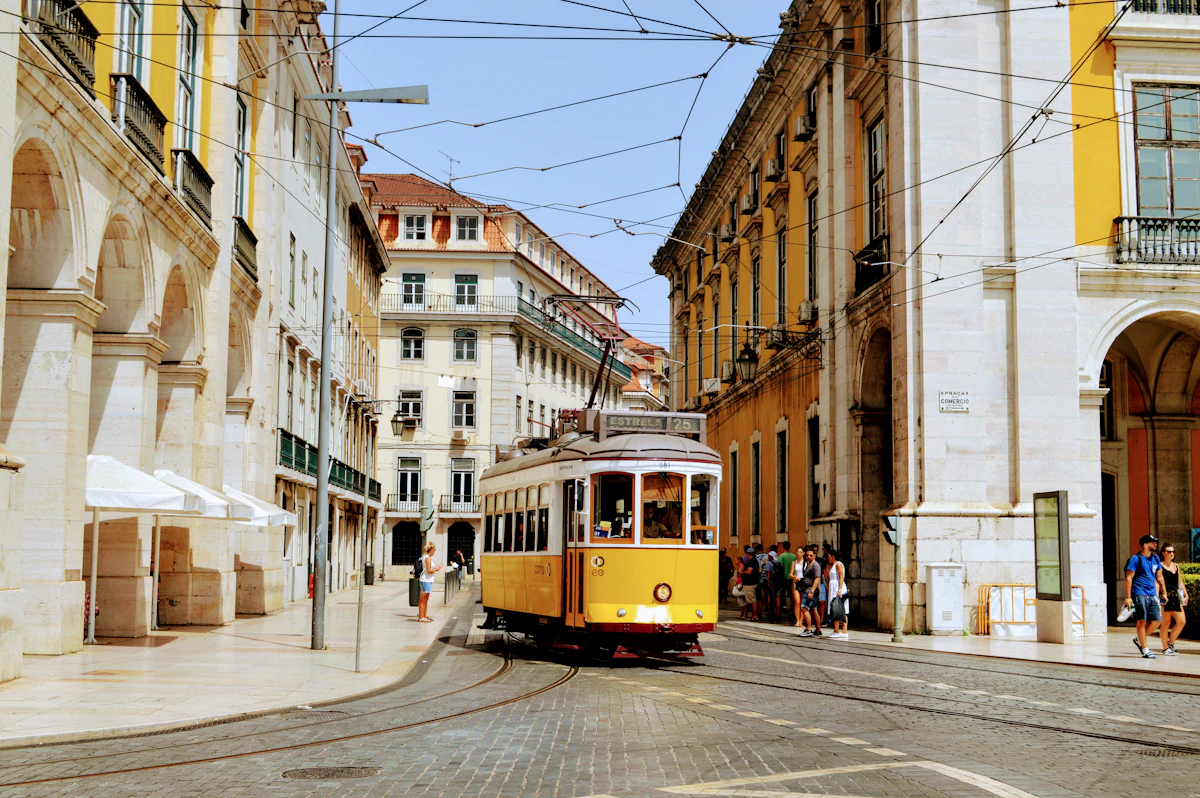
Portugal is built on gradients that flat maps hide. Lisbon climbs steeply enough to need the Glória and Bica funiculars and tram 28, its metro platforms sit deep and tunnelled, and Alfama's lanes are narrow enough that positioning wanders between them. Porto occupies a granite river gorge, where the Guindais funicular drops from Batalha to Ribeira in three minutes and the Dom Luís I Bridge carries the metro high above the Douro. The Algarve runs about 200 kilometres of cliff coast with cove floors ringed by limestone. Save the route and the ticket at street level, before the descent.
Refund policy
Get a full refund within 7 days if no data is used, even after installation. If it doesn't work and we can't fix it, we refund you.
Activation window
Check the package details for the first-use deadline and validity rules.
Secure checkout
Cards, Apple Pay & Google Pay — encrypted by Paysera.
Customer support
Contact support before or during your trip if you need help.
Add the Portugal profile before you travel, on a connection you already trust, and keep the order details off the handset. Whatever step the plan names for the point where it becomes the data line, finish it at street level, because Lisbon's metro platforms sit deep and tunnelled and Porto's Guindais funicular drops from Batalha to Ribeira in three minutes. The airport transfers are unusually easy here: Lisbon's airport is about seven kilometres out with a metro line running straight into the city, and Porto's about eleven with a metro reaching the centre in roughly twenty-five minutes. Faro puts you a short bus ride from the Algarve regional railway. Leave the home contract's data switched off unless being billed is a decision you have made: the A22 runs east to the Spanish border, and Porto connects to Galicia by cross-border train.
Pick a destination, data allowance and validity period.
Scan the QR or auto-install in the app — no physical SIM.
Data activates on first connection at your destination.
Pick the profile closest to your trip. The estimate assumes normal use — maps, messaging, photos, a short call home.
As a rule of thumb, a 3–4 day city break runs on about 1–3 GB, a one-week trip on 3–5 GB, a two-week multi-country tour on 8–12 GB, and working on the road takes about 1 GB a day, so 15 GB or more for two weeks.
In total, a 5 GB data allowance covers roughly 1,700 shared photos, 83 hours of social media and browsing, 15 hours of video calls, 63 hours of music streaming, or about 1000 hours of maps and navigation. Messaging apps barely use data.
Lisbon · City guide
Lisbon holds the Jerónimos Monastery and Belém Tower out at Belém, São Jorge Castle above Alfama and the Gulbenkian Museum inland. The city is steep enough that the Glória and Bica funiculars and tram 28 exist to climb gradients a street map flattens, its metro platforms are deep and tunnelled, and Alfama's lanes are narrow enough that positioning drifts between them. Sintra is thirty kilometres away, about forty minutes by suburban train from Rossio with departures roughly every twenty minutes. Load the route above ground.
Lisbon eSIM — set up before you fly →Porto · City guide
Porto keeps the Livraria Lello, the 75-metre Clérigos Tower with its 225 steps, the tiled hall of São Bento station and the Serralves museum and gardens about fifteen minutes out. The city sits in a granite river gorge, which is the thing to plan around: the Guindais funicular drops from Batalha to Ribeira in three minutes, and the upper deck of the Dom Luís I Bridge carries the metro high over the Douro. Pinhão in the Douro valley is about two and a quarter hours by train from São Bento.
Porto eSIM — set up before you fly →The Algarve · City guide
The Algarve runs roughly 200 kilometres of cliff coast, with Ponta da Piedade at Lagos, Sagres and Cape St Vincent at the western end, and the Benagil sea cave reachable only by boat. Towns are strung along the A22 motorway, so days involve long road legs and cove floors ringed by tall limestone. Praia da Marinha and Benagil anchor the cliff-and-cove stretch while Meia Praia at Lagos is the long flat one. The regional railway links Lagos, Portimão, Albufeira, Faro and Tavira, which covers the towns but not the coves.
The Algarve eSIM — set up before you fly →Sintra · City guide
Sintra has been a UNESCO cultural landscape since 1995, holding Pena Palace, the Castelo dos Mouros and Quinta da Regaleira with its 27-metre Initiation Well. Everything sits in the forested and often misty Serra de Sintra, reached by one winding uphill road under dense tree cover, which is why timing and tickets matter more than distance. It is thirty kilometres from Lisbon and about forty minutes by train from Rossio, and two palaces in a day is realistic rather than four. Book and download before the climb.
Sintra eSIM — set up before you fly →Why Horizon
Seven to ten days covers Lisbon and Porto with a day trip from each, and the rail spine makes that easy: the fast train runs Lisbon to Porto in about two and a half to three hours, and Sintra is forty minutes from Rossio. The Algarve is the separate decision, roughly 270 kilometres and three hours south of Lisbon, where a car stops being optional if the coves matter. Season is sharp here — July and August fill the Algarve and empty it again after August, while May, June, September and October give similar warmth with far more space. One coverage point to settle before booking: Madeira and the Azores are separate Atlantic island regions reached only by air, so check them by name rather than assuming a mainland plan reaches them.
Plan for
Portugal
Compare the listed data allowances and validity periods for your destination.
Install over reliable Wi-Fi before departure and follow the plan's activation instructions.
Review the current price, data, validity, coverage and fair-use terms before checkout.
When the selected plan supports reuse or top-ups, My eSIMs shows the eligible options for the installed profile.
We'll alert you as you approach your limit. If the plan supports a top-up, My eSIMs shows the eligible options.
Choose country, regional or global coverage and check every destination in the plan details.
Check the printed list rather than assuming either way. Both are Atlantic island regions of Portugal, reached only by air from the mainland and far out in the ocean, and they are normally planned as their own trip rather than as an extension of a Lisbon or Porto week. That separateness is exactly why the destination list matters here: a plan can name the mainland without naming the islands. If either is on the itinerary, confirm it by name on the exact offer before paying.
Lisbon is bigger and better connected, with Belém, the Gulbenkian and Sintra forty minutes away by train; Porto is more compact and arguably easier to absorb in a short stay, with the Douro valley two and a quarter hours upriver. If the trip is three or four days, Porto rewards the shorter visit. If it is a week, take Lisbon and use the fast train north for two nights, which runs the 274 rail kilometres in about two and a half to three hours.
Yes, by train, and the honest limit is two palaces rather than four. It is thirty kilometres from Lisbon, about forty minutes from Rossio with departures roughly every twenty minutes, and everything sits up in the forested and often misty Serra de Sintra on one winding road under dense tree cover. Pena Palace, the Castelo dos Mouros and Quinta da Regaleira with its 27-metre Initiation Well each take real time. Book timed entries and download them before leaving the station.
For the towns no, for the coves effectively yes. The regional railway links Lagos, Portimão, Albufeira, Faro and Tavira, which covers where people stay, but the coast itself runs about 200 kilometres of cliff with towns strung along the A22 and the best cove floors reached by road or on foot from above. The Benagil sea cave is the clearest case of all, since it can only be reached by boat. Decide by what you actually want to see rather than by the base.
May, June, September and October are the sweet spot — similar warmth to high summer with far more space. July and August run 28 to 35 degrees, fill the Algarve and make rooms scarce, and the strip empties sharply once August ends. The water is Atlantic and stays cool: roughly 16 to 19 degrees in summer on the Lisbon coast, 15 to 18 around Nazaré and Peniche, and 19 to 23 on the Algarve's south-facing side. September to November suits surfers, with better swell and still-workable water.
Only when Spain is named on the plan's own destination list. The pairing is common — a loop through Madrid, Seville, Évora, Lisbon and Porto is a standard route — but the connections are less direct than people expect. There is no direct Lisbon to Seville train, so the usual options are a bus via Faro of about six and three quarter hours or a flight, and Lisbon to Madrid is normally flown or bussed too. In the north, Porto connects to Vigo in Galicia by cross-border train and bus. Read the list before booking either leg.
Because the lanes are narrower than the positioning is precise, and the buildings on either side are tall and close. Alfama is the clearest example in the country, and Porto's Ribeira behaves similarly in its granite gorge. Neither is a fault in the plan. The same goes for the deep metro platforms in both cities and the Guindais and Glória funiculars between levels. Load the walking route at street level before descending, and judge whether a profile is working out in the open rather than three storeys down a stepped lane.