




For anyone leaving a northern winter behind, Egypt between November and March is the obvious escape. In December and January the Red Sea coast at Hurghada and Sharm el-Sheikh reaches the low twenties by day, Luxor and Aswan are a touch warmer in the afternoon and colder at night, Luxor especially, and Cairo sits around twenty degrees. Each kind of trip has its place: the Red Sea for sun and reefs, the Nile between Luxor and Aswan for the temples, and Cairo for the pyramids and the Grand Egyptian Museum, which opened its doors on 1 November 2025.
The data question is the same on every leg. The EU's roam-like-at-home rule does not reach Egypt, so what your home line costs there is set by your own tariff's terms for Egypt. Decide before you fly: find the Egypt line in your tariff, set it against an Egypt eSIM installed at home, and keep your usual number in the phone for calls and bank codes. The Egypt buyer's guide covers networks and plan choice; this one follows the trip.
Three winters: the coast, the valley and Cairo
The Egyptian Meteorological Authority's long-term averages describe three winters, and the difference decides what you pack.
- The Red Sea coast. From December to February, Hurghada and Sharm el-Sheikh average twenty-two to twenty-three degrees by day and eleven to fifteen at night, and rain is rare; November and March run several degrees warmer. Wind matters more than the thermometer, and El Gouna and Dahab are wind-sports towns for a reason.
- Luxor and Aswan. Afternoons average twenty-three to twenty-five degrees in midwinter, but January nights in Luxor average about six, and a sunrise balloon over the West Bank goes up in the coldest hour. Pack a warm layer.
- Cairo. Around nineteen to twenty degrees by day and ten at night, with a few days of light rain in an average month.
The light goes early in midwinter, so fit temples and boat trips into the daylight. Egypt's clocks go back on the night of 29 to 30 October 2026 and stay on winter time until late April.
The Red Sea: a resort week runs on Wi-Fi until the boat leaves
Choose the coast by its airport. Hurghada's airport is about five kilometres from the town centre, with El Gouna to the north and the resort bays of Sahl Hasheesh and Makadi to the south. Marsa Alam's airport sits some sixty kilometres north of the town, so a hotel near the town means a long transfer. Sharm el-Sheikh has its own airport, with Dahab under a hundred kilometres to the north-east.
Inside a resort the phone mostly rides on hotel Wi-Fi, which most hotels offer. Mobile data earns its place in the gaps: the transfer, when the driver's number sits in a booking email; an evening in town; and above all the boat days.
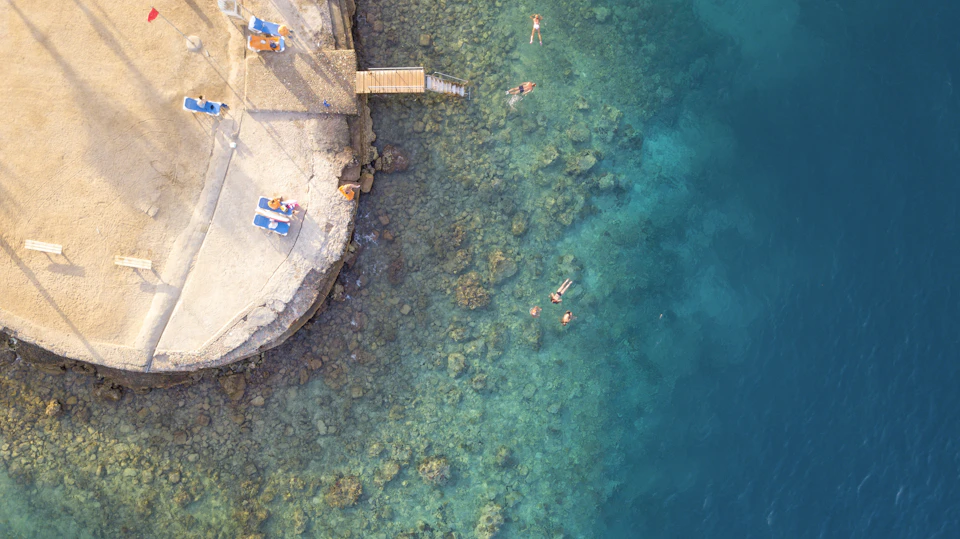
A snorkelling trip to the Giftun islands off Hurghada, a day on the reefs of Ras Mohammed from Sharm, or a dive boat out to the wrecks in the Strait of Gubal can take you far enough offshore that reception depends on the distance and the shape of the coast. Before stepping aboard, save the pickup point, the boat's name and the guide's number in the phone itself rather than in an app that needs a connection. If the wind moves a trip while you are away from the hotel Wi-Fi, the dive centre's message reaches you only on a line that has data.
On the Nile: four or five days between Luxor and Aswan
A cruise between Luxor and Aswan usually takes four or five days, depending on the direction, and most itineraries share the same stops: Karnak and Luxor Temple in the town, the Valley of the Kings across the water on the West Bank, then south past Esna to the temples of Edfu and Kom Ombo, and Philae at Aswan. Boats pass the lock at Esna, where a cruise can be held up for hours. Dahabiyas, two-masted sailing boats, work the same stretch, and a felucca gives you an afternoon on the water at either end.
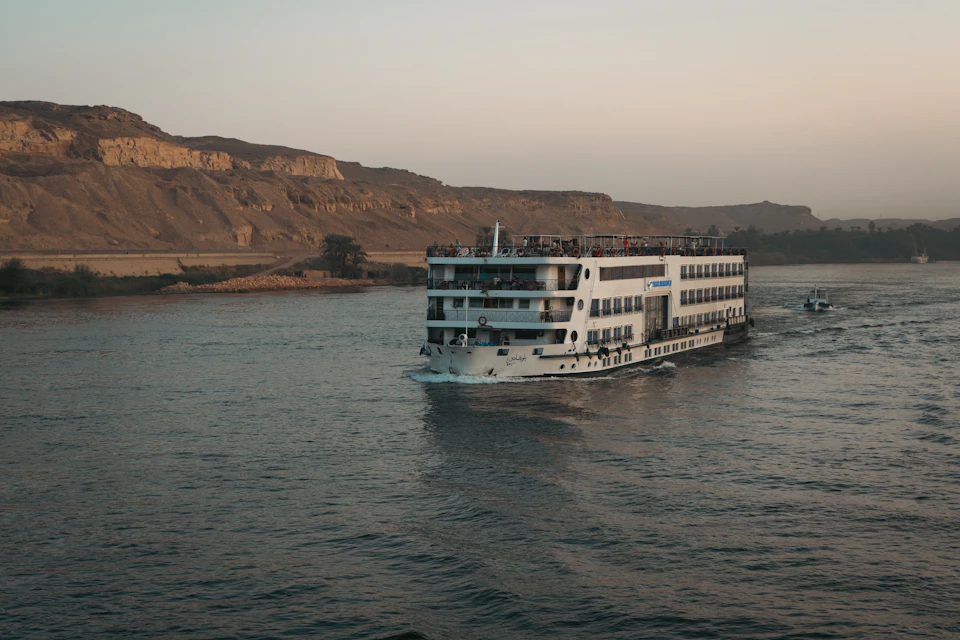
Brochures skip what the phone does on board. A boat on the river has no cable to the shore, so whatever Wi-Fi it offers arrives over the air and is shared by everyone on board at once. Ask whether it reaches the cabins or only the lounge, and treat it as a bonus rather than the plan. Between towns the river runs past fields and desert, and a phone can lose the network until the next town brings it back.
Abu Simbel, far to the south on Lake Nasser, is a long day out from Aswan by desert road or a short flight, and on that road a phone can go quiet for long periods.
Tip: The evening before you sail, put the phone in airplane mode and open everything you will want on board: the offline map, the downloaded episodes, the booking for the far end. Whatever opens then will open on the river.
Cairo and Giza: the new museum is booked online
The Grand Egyptian Museum stands near the Giza pyramids on the Cairo-Alexandria desert road. Tickets are sold online only, for a timed entry slot, on the museum's official ticketing site, which asks for a code sent to your email during booking. Buy on hotel Wi-Fi the evening before, save the confirmation where it opens without a connection, and build the ride out around the slot.
Getting there is a mobile-data job. Ride-hailing apps are widely used in Greater Cairo, which means sharing a pickup pin and watching a car creep towards you on a map; street taxis are required by law to run a meter. Traffic can stretch a short hop, so leave a margin before a timed slot, and carry cash for taxis and small shops.
Visas, the Sinai stamp and the 2026 phone rule
Many nationalities can choose an e-visa in advance or a visa on arrival. Egypt's official e-visa portal lists the eligible passports, asks you to apply at least seven days before departure and to carry a printout, and wants six months of passport validity from the day you arrive. Flying straight into Sharm el-Sheikh for under fifteen days, you can instead get a free entry stamp covering the South Sinai resorts, Dahab included, but not Cairo or the Nile. Check the rules for your own passport before booking.
One rule changed in 2026. Since 21 January, Egypt has charged duty and fees on mobile phones brought in from abroad, and the notice from the National Telecom Regulatory Authority keeps a tourist's phone exempt for 90 days. Egyptian press reports of it add that visitors may use their phones on a foreign SIM as normal, and that a local tourist SIM falls under the same window; buying one means a shop visit with your passport, which the operators copy. A winter holiday sits well inside that; longer stays should check the current notice.
How much data a Red Sea week or a two-week trip needs
A Red Sea week on hotel Wi-Fi needs little. Transfers, two or three boat days, messages and a few photos sent home fit a modest allowance, and a 3 GB plan over seven days leaves headroom. Count the calendar, though: a seven-night package touches eight dates, so set the plan's validity against your flight times rather than the brochure's week.
A two-week trip combining Cairo, a cruise and a few days on the coast is heavier. The river days lean on mobile data because the boat's Wi-Fi is shared, and a Cairo day runs on maps and ride-hailing from breakfast to dinner. That trip suits something like 10 GB over thirty days. The Egypt eSIM page lists the current sizes; where the selected plan supports a top-up, the same line takes more data.
Adding Petra or Wadi Rum? Horizon sells Jordan as a separate destination, and the Middle East eSIM currently puts Egypt on one list with Turkey, Israel, Saudi Arabia, Kuwait, Qatar and Oman, but not Jordan.
Install before you fly, turn the Egypt line on after landing
- Install on your home Wi-Fi a few days ahead. The installation guide covers the steps; keep the email with the QR code and manual-entry details away from the phone being set up.
- Keep the Egypt line off until passport control and the baggage hall are behind you. Its validity does not start until the eSIM first connects to a supported network in Egypt.
- Next, change three settings. Make the Egypt line the one for mobile data, allow data roaming on the Egypt line and nowhere else, and switch mobile data off for your home number, which still takes calls and the bank's texts.
- Save the first day offline: the hotel address, the transfer booking, the museum slot, and two numbers from the tourism ministry's list: the tourist police on 126 and the ambulance on 123.
Short answers
Is winter a good time to visit Egypt? Yes for the Nile and Cairo: Egypt's tourism ministry names October to May as the best time for a cruise, and Cairo is around twenty degrees by day. The Red Sea is mild rather than hot, in the low twenties.
What is the weather like in Hurghada in December? About twenty-three degrees by day and thirteen at night on long-term averages, and rain is rare. January runs a degree or two cooler.
Does my phone plan work in Egypt? On whatever terms your operator sets for Egypt, which the EU's roam-like-at-home rule does not cover. Read the Egypt line in your tariff, or install an Egypt eSIM at home and keep your number on the home line.
Is there internet on a Nile cruise? Ask the boat: any Wi-Fi it has comes over the air and is shared by everyone aboard, and between towns the phone's own reception can drop. Download maps and entertainment before sailing.
Do tourists have to pay duty on their phones? Not on a normal holiday: the regulator's January 2026 notice keeps a tourist's phone exempt for 90 days. Longer stays should check the current rules.
Do I need to book the Grand Egyptian Museum in advance? Yes. Tickets are sold online only, for a timed slot, on the museum's official ticketing site.
Hotspot sharing is free on every Horizon plan.
