




A northern lights trip is a data job before it is a photo job. The chase runs on your phone: the space-weather forecast, the cloud map, the guide's message about pick-up, the road to a dark spot and back. At the end of the night the same phone is your camera, and on the walk back it is your torch. The cold works against all three. Apple designs the iPhone for 0 to 35 degrees Celsius, and clear aurora nights in Tromsø, Lapland and Iceland are often below freezing. Prepare three things: a data plan that names every country your chase might cross, offline maps, and a routine that keeps the battery warm.
Your roaming situation decides the rest. On a plan from an EU or EEA country, the EU's roam-like-at-home rule applies in all four countries, Norway and Iceland included as EEA members, within your operator's fair use policy. On a plan from anywhere else, including the UK and Switzerland, your operator's own roaming terms set the cost, and a travel eSIM for the data is the usual answer.
The season is set by darkness, the night by cloud
The tourism boards agree on the window: late August to early April, when the nights are dark enough, though Visit Norway ends in late March. Visit Norway and Visit Finland call autumn and spring statistically the most active periods, around the equinoxes, while midwinter brings the longest darkness, including Tromsø's polar night, which Visit Tromsø dates from late November to late January. The active hours are late evening to about 02:00.
Cloud decides most nights. Visit Finland calls it the most common reason people miss the lights, and the Icelandic Met Office says the aurora needs dark and partly clear skies. A big storm is not required: the same office notes that even low activity on its scale can be beautiful. NASA and NOAA announced on 15 October 2024 that the Sun had reached the maximum period of its cycle, which NASA said could last about a year, adding that fairly significant storms often come in the declining phase too. Nobody can forecast a whole season; the forecasts worth reading cover the next few nights.
Four bases, four ways of chasing
Tromsø. Visit Norway calls it the main hub for northern lights trips, with direct international flights, and lists Alta, Senja and Lofoten as alternatives. Many visitors stay in town and join a guided bus chase. When the Norwegian side is too cloudy, the Northern Norway tourist board says crossing into Finland, towards Kilpisjärvi, is sometimes needed: a night that starts in Norway can end in another country.
Finnish Lapland. Rovaniemi sits on the Arctic Circle; Kittilä airport serves Levi, and Ivalo, Finland's northernmost, serves Saariselkä and Inari. You stay in a cabin or resort away from street lights and go out on foot, by snowmobile or with a guide, or watch from bed in a glass cabin. By Visit Finland's count, the aurora shows on roughly every other clear night in Lapland in season.
Swedish Lapland. Abisko lies about a hundred kilometres north-west of Kiruna, Sweden's northernmost city; from Kiruna you continue by train or bus. Visit Sweden says the national park often has clear skies when nearby areas are cloudy. The Aurora Sky Station on Mount Nuolja is reached by chairlift; book it ahead in high season.
Iceland. The lights can show over Reykjavík, but Visit Reykjavík advises leaving the city glow and names the Grótta lighthouse as a close option. You chase by rental car or with a tour, with the Icelandic Met Office's aurora forecast open: activity on a scale from 0 to 9, and a cloud map where green means cloud and white means clear sky.
What the chase uses data for, and how much to buy
An aurora night is light on data but constant: a forecast app, satellite cloud images through the evening, a map, the guide's messages. Many aurora apps push an alert when activity passes a level you set, and the alert only reaches you if the phone has a connection at that moment. The Kp index many apps quote runs from 0 to 9, with 5 and above a geomagnetic storm in NOAA's definition, but Visit Reykjavík notes that clear skies often matter more than a high Kp.
The heavy item is photos. Night-mode shots and video clips sent from the road, or a cloud backup running on mobile data, can outweigh the rest of the week. For a Tromsø week with photos waiting for Wi-Fi, a 5 GB plan over seven days is a reasonable size; if you post clips at one in the morning, look at 10 GB. The Norway eSIM page lists the current sizes, as do the Finland, Sweden and Iceland pages. On a compatible device, a single phone can share its data with a partner's phone in the car, so size the allowance for two.
Roaming, one country or four, and the ship problem
On an EU or EEA plan, start with what you already pay for: the EU's roaming rules cover all four countries, and the limit to check is your operator's fair use policy for data. If it covers the week, you may need nothing else. On a plan from elsewhere, read what your tariff says for each country by name; a zone called Europe is only as good as its list.
One base means one country's page. A trip that combines bases, such as Tromsø with Abisko or Rovaniemi, or a chase that ends at Kilpisjärvi, is the case for the Europe eSIM, which names Norway, Sweden, Finland and Iceland on its current destination list; check it before you pay. Install at home on Wi-Fi with the installation guide, and check the listing's validity line, which says which event opens the window.
At sea, a coastal cruise or a ferry may put the phone on the ship's own network, which can run over satellite. The EU says you should not be charged extra while connected to a land-based network, but satellite service falls outside its rules, and it advises switching roaming off or using airplane mode on board. With a travel eSIM, check the network name before using data at sea; if your plan does not list it, turn data roaming off for that line.
Where the network thins out, and what to set up before dark
These are large, thinly settled regions, and any network can drop out on a remote road, deep in a fjord or up on a fell; how far a signal carries depends on the terrain and the network. Prepare for gaps:
- Download offline maps on Wi-Fi, including the roads inland from Tromsø.
- Screenshot the tour confirmation, the pick-up point and the company's number.
- Tell someone your route. Iceland's Safetravel asks every traveller to leave a travel plan with a contact who is not on the trip.
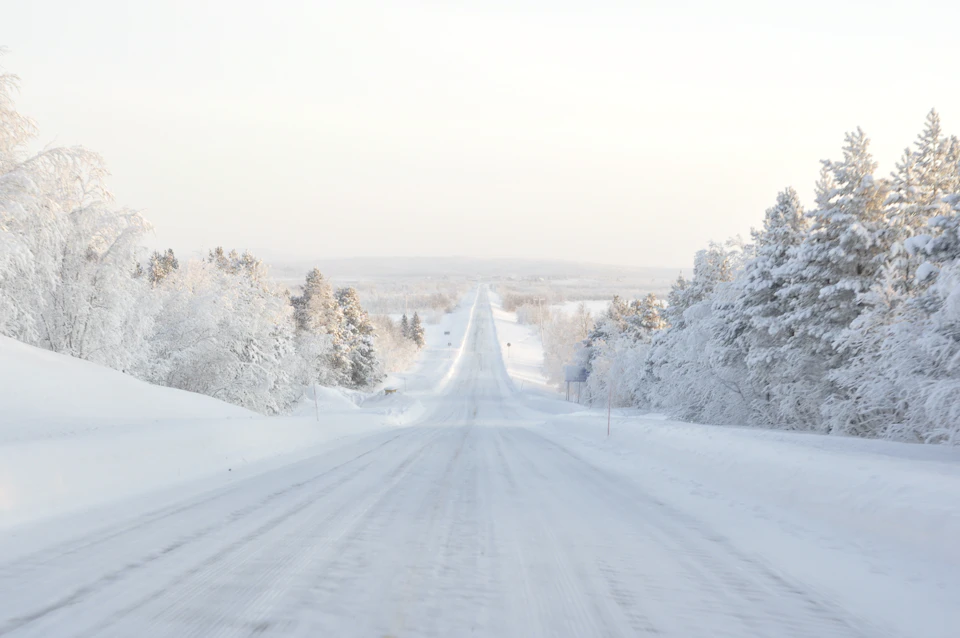
- If you drive, keep to the main roads: the Northern Norway tourist board warns that drivers new to winter conditions can easily end up off the road. Stop only where you can pull off safely.
If the status bar says SOS, the phone has lost its own network but can still make emergency calls over another one in range; what SOS means explains the rest. 112 works in all four countries. In Norway it reaches the police, with 113 for medical emergencies and 110 for fire.
Photographing the aurora with a phone
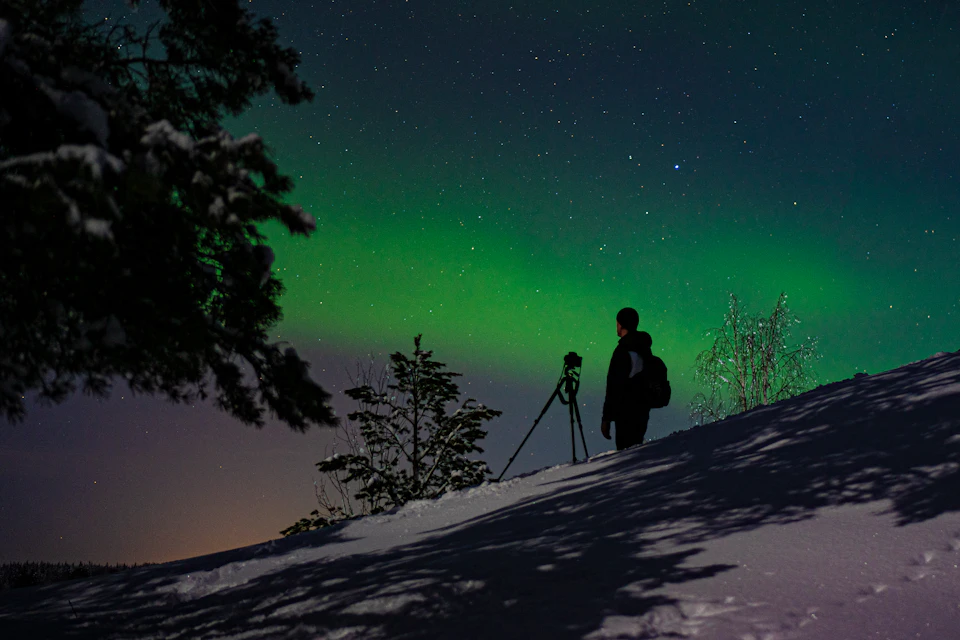
Night mode works on the iPhone 11 and later and engages in low light; a number beside its icon shows how long the shot will take. Apple advises holding the phone still or, better, setting it on a solid surface or a tripod, and the slider above the shutter button can go to Max for a longer capture. Most recent Android phones have a night or manual mode; menus vary by maker.
- A small phone tripod or a clamp beats the steadiest hand.
- Turn the flash off and the screen brightness down, so your eyes stay used to the dark.
- Take test shots while the aurora is faint, and adjust before it peaks.
- While you shoot, airplane mode stops the phone hunting for a signal and can save battery.
Keeping the phone alive in the cold
Apple's page on hot and cold conditions says a device used in very cold conditions outside its operating range might temporarily shorten battery life and could turn off, that one that gets too cold might not charge, and that battery life returns to normal once it warms up.
- Start each evening at full charge, with a power bank and a short cable in an inside pocket, and warm the phone under your jacket before plugging it in.
- Keep the phone against your body between shots, not in an outer pocket.
- Wear touchscreen gloves, or thin liners under mittens.
- Do not leave the phone in a parked car, where Apple warns temperatures can go beyond its range.
Short answers
When is the northern lights season? Roughly late August to early April. Autumn and spring are statistically the most active; midwinter has the longest nights.
Does my EU plan work in Norway and Iceland? Yes, within your operator's fair use policy: both apply the EU roaming rules.
Can one eSIM cover Norway, Finland, Sweden and Iceland? The Europe eSIM names all four on its current destination list; check it before you buy.
How much data does an aurora trip need? Forecasts, maps and messages take little; photos and videos sent over mobile data add up. For a week with uploads saved for Wi-Fi, 5 GB is a reasonable start.
Will the cold drain my phone? It can: Apple says very cold conditions might temporarily shorten battery life and could switch the device off. Keep it warm.
Hotspot sharing is free on every Horizon plan.


