



Buy a plan
Pick a destination, data allowance and validity period.






Compare Uzbekistan eSIM plans for Tashkent, the Registan in Samarkand, the Poi Kalon ensemble in Bukhara and the walled Ichan Kala at Khiva. Set the data against the number of travel days, then read the territory and hotspot wording named on the offer itself.
Uzbekistan divides into two halves for anyone carrying a phone. Tashkent, Samarkand and Bukhara sit on one corridor — 344 kilometres from the capital to Samarkand, another 256 on to Bukhara — and a high-speed service links all three inside a single day. Khiva sits apart, 430 to 520 kilometres west of Bukhara depending on the route, across the Kyzylkum Desert on a paved two-lane highway with long gaps between settlements. That is the geography behind every itinerary here, and it is also where the data question actually lives.
Refund policy
Get a full refund within 7 days if no data is used, even after installation. If it doesn't work and we can't fix it, we refund you.
Activation window
Check the package details for the first-use deadline and validity rules.
Secure checkout
Cards, Apple Pay & Google Pay — encrypted by Paysera.
Customer support
Contact support before or during your trip if you need help.
Add the Uzbekistan profile at home over Wi-Fi and keep the order paperwork off the handset. The offer names the step at which the profile becomes the data line; follow that wording rather than guessing at it. Before arrival in Tashkent, check the airport's current ground-transport guidance for your terminal and destination, and save your transfer details. Save the Ichan Kala and Registan maps and your rail times offline before the Kyzylkum leg.
Pick a destination, data allowance and validity period.
Scan the QR or auto-install in the app — no physical SIM.
Data activates on first connection at your destination.
Pick the profile closest to your trip. The estimate assumes normal use — maps, messaging, photos, a short call home.
As a rule of thumb, a 3–4 day city break runs on about 1–3 GB, a one-week trip on 3–5 GB, a two-week multi-country tour on 8–12 GB, and working on the road takes about 1 GB a day, so 15 GB or more for two weeks.
In total, a 5 GB data allowance covers roughly 1,700 shared photos, 83 hours of social media and browsing, 15 hours of video calls, 63 hours of music streaming, or about 1000 hours of maps and navigation. Messaging apps barely use data.
Tashkent · City guide
Tashkent is the arrival city and the only one on the circuit with a metro. The Hazrati Imam Complex holds an early Quran manuscript, Chorsu Bazaar trades under a domed roof, and Independence Square and Amir Timur Square anchor the centre. The decorated metro stations are themselves a sight; save what you need offline before going underground. Check the airport's current ground-transport guidance for your terminal and destination before planning the transfer into town.
Tashkent eSIM — set up before you fly →Samarkand · City guide
Samarkand is the reason most itineraries exist at all. Registan Square gathers three Timurid madrasas — Ulugh Beg, Sher-Dor and Tillya-Kori — around one open plaza, while the Gur-e-Amir Mausoleum holds the tomb of Timur. Shah-i-Zinda runs as an avenue of blue-tiled mausoleums and the Bibi-Khanym Mosque closes the set. The city sits 344 kilometres from Tashkent, a little over two hours by high-speed train. Its own airport is about six kilometres out, ten to fifteen minutes by taxi.
Samarkand eSIM — set up before you fly →Bukhara · City guide
Bukhara keeps its old centre whole and walkable. The Poi Kalon ensemble sets the Kalon Minaret, about forty-eight metres tall, beside the Kalon Mosque and the Mir-i-Arab Madrasah; the Ark Fortress stands above the town, and Lyab-i Hauz gathers sixteenth and seventeenth century madrasas around a pond. Old trading domes still roof the lanes between them, and those lanes are dense mudbrick and stone, which is where a handset loses the mast. Samarkand is 256 kilometres back, about an hour and a quarter by rail.
Bukhara eSIM — set up before you fly →Khiva · City guide
Khiva is the one that costs a day to reach. Ichan Kala, the walled inner town, is a UNESCO site with more than fifty monuments and around two hundred and fifty historic houses inside it: the Kunya-Ark Citadel, the Juma Mosque and its forest of carved wooden columns, and the unfinished turquoise Kalta Minor. From Bukhara it is 430 to 520 kilometres of Kyzylkum Desert highway, six and a half to eight hours on a paved two-lane road with long empty stretches. Urgench airport lies thirty to thirty-five kilometres away.
Khiva eSIM — set up before you fly →Why Horizon
The circuit decides the plan more than the map does, so count the travel days first: seven to ten for all four cities, fewer if Khiva comes off the list. April to early June and September to October are the months to aim for, since July and August reach 35 to 40°C in the desert and January sits near zero. Then check the offer's territory line names Uzbekistan itself, not a wider region the trip never enters.
Plan for
Uzbekistan
Compare the listed data allowances and validity periods for your destination.
Install over reliable Wi-Fi before departure and follow the plan's activation instructions.
Review the current price, data, validity, coverage and fair-use terms before checkout.
When the selected plan supports reuse or top-ups, My eSIMs shows the eligible options for the installed profile.
We'll alert you as you approach your limit. If the plan supports a top-up, My eSIMs shows the eligible options.
Choose country, regional or global coverage and check every destination in the plan details.
For the three cities on the rail corridor, the train is the faster option by a wide margin. Tashkent to Samarkand is 344 kilometres and takes about two and a quarter to two and a half hours; Samarkand to Bukhara is 256 kilometres in roughly an hour and a quarter; Tashkent straight through to Bukhara runs three and a half to four hours. A car covers the same ground on ordinary roads. A driver earns its place only when the plan includes stops that no station serves.
Seven to ten days is the usual answer, and the split matters more than the total. The rail corridor lets Tashkent, Samarkand and Bukhara sit close together, so most of the extra time goes on Khiva, which is a separate journey rather than a stop on the way. A shorter trip usually means dropping Khiva and giving Samarkand and Bukhara two nights each instead of one.
All three are real choices. The drive from Bukhara is 430 to 520 kilometres across the Kyzylkum Desert depending on the route, six and a half to eight hours on a paved two-lane highway with sparse settlement along it. A domestic flight into Urgench leaves a thirty to thirty-five kilometre transfer, thirty to forty minutes, into the old town. A newer high-speed rail link runs Tashkent to Khiva in about seven hours. Dropping Khiva is defensible on a short trip; the desert leg is the part that eats a day.
April to early June and September to October are the windows most itineraries aim for. July and August bring daytime highs of 35 to 40°C, and the desert regions can go past that, which changes how long anyone stands in an open square like the Registan. January averages around zero to minus five degrees, colder in the north. October is the popular shoulder month, with mild clear days near 17°C.
They pull in different directions. Samarkand is the bigger draw and the better rail hub: 344 kilometres from Tashkent, 256 from Bukhara, with its own airport six kilometres from the centre. Bukhara is the more compact and the more walkable, an old town you cross on foot rather than by taxi, and it is the natural jumping-off point for the desert road west to Khiva. Pick Samarkand for monuments and connections, Bukhara for atmosphere and for the Khiva leg.
Treat it as a separate expedition rather than a detour. Moynaq sits in the far northwest, in remote steppe and desert with minimal infrastructure, and the Aral Sea there has largely dried out — the draw is the ship graveyard on what used to be the shore. Nothing about that stretch resembles the Silk Road circuit in travel time or in services along the way. If it goes on the plan, it goes on as extra days, with maps saved offline first.
Geographically yes — but a plan sold for Uzbekistan is sold for Uzbekistan, so read the territory list on the offer before assuming a border changes nothing. The eastern approach towards the Fergana Valley crosses the Kamchik Pass at around 2,268 metres, which can close briefly in heavy winter weather, though a tunnel now bypasses part of the route. What a handset actually gets there depends on the plan chosen, the device, the exact spot and the mountain between you and the nearest mast.
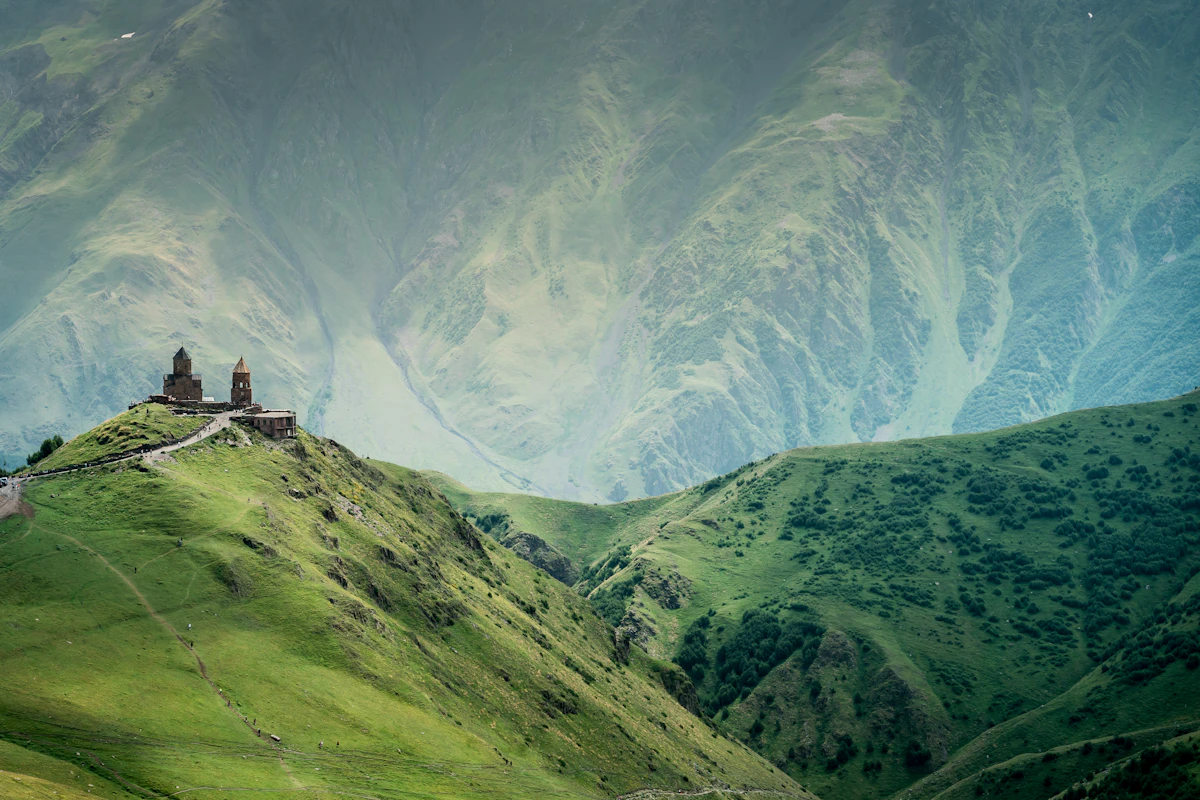
The overland arc from the South Caucasus into Central Asia crosses six separate mobile markets. One regional profile currently reaches Armenia, Azerbaijan, Georgia, Kazakhstan, Kyrgyzstan and Uzbekistan — here is how to plan the data side of the whole journey at home.

Almaty, Bishkek, Tashkent, Samarkand and Bukhara across three separate mobile markets, joined by long road and rail legs. How to size data for a Silk Road route and what to prepare before each leg.


